Module 5: Memory — Parametric, Working (Short-Term), and Long-Term
Hi again! We've covered LLMs, training, RAG, and tools. Before we get to agents, there's one idea that quietly underlies everything we've done so far: LLMs don't actually remember anything on their own. There isn't just one kind of "memory" either — there are three, and they behave very differently. Let's break them down.
I. Three Types of Memory
- Parametric memory (offline / permanent) — knowledge baked into the model's weights during training or fine-tuning.
- Short-term memory, a.k.a. working memory (online / temporary) — whatever is currently sitting inside the LLM's context window, right now.
- Long-term memory (online / temporary) — a summary or index of past conversations/documents, stored outside the model, that gets retrieved back into working memory when needed.
Let's go through each one.
II. Parametric Memory: What's Baked Into the Weights
Remember Module 2, where we trained and fine-tuned models? When you fine-tune a model on, say, a pile of legal documents, that information gets stored permanently inside the model's weights (its parameters).
- Permanent: it doesn't disappear when the session ends, and you don't need to resend it every call — it's just in the model.
- Imprecise at scale: the problem is that a model's weights hold an enormous amount of information — billions of documents' worth. Cramming your specific document in among all of that makes it hard for the model to memorize and retrieve it exactly.
Think of it like a person who has read 1,000 books. They generally know what those books were about, but ask them to quote page 214 of book #537 word-for-word, and they'll struggle — the information is in there somewhere, just not precisely retrievable.
III. Short-Term Memory (a.k.a. Working Memory): What's In Context Right Now
It's worth calling this memory what it really is: working memory. It's the memory the LLM is actively "working with" at this exact moment — literally whatever text is sitting inside its context window right now.
Compare it to the person-with-1000-books analogy: working memory is like that same person, except now they have one specific book open right in front of their eyes. They don't need to recall anything from a hazy memory of everything they've ever read — they can just read it directly. That's why LLMs perform so much better with working memory than with parametric memory: the information isn't buried among billions of other documents, it's right there in front of them.
The catch: working memory is limited in size (e.g. 200K or 1M tokens) and it can fill up. And the moment you start a new session — opening a new Claude Code or ChatGPT conversation — it's gone. Every new session starts with a completely empty context window, because the LLM keeps no state of its own between sessions.
LLMs Are Stateless During Generation
Important distinction: LLMs are stateless during generation (this is different from training, which is a one-time process that produces parametric memory). During generation — i.e. every time it's actually replying to you — the model saves nothing on its own. Every single message you send is, technically, a brand new, independent call to the LLM, as if it were a new session, because the LLM itself keeps no state of the conversation.
So how does it feel like a continuous conversation? Because we fake it. We keep a growing stack of every message exchanged so far, and every time something new happens — you send a message, or the LLM generates a reply — we append it to that stack, and then send the entire stack back to the LLM on the next call.
ASCII Art:
Stack: []
You: "Hi, I'm Aylin"                 -->  append  -->  Stack: [Human: "Hi, I'm Aylin"]
                                                        send WHOLE stack to LLM
LLM generates: "Hello Aylin!"        -->  append  -->  Stack: [Human: "Hi, I'm Aylin", AI: "Hello Aylin!"]

You: "What's my name?"               -->  append  -->  Stack: [..., Human: "What's my name?"]
                                                        send WHOLE stack to LLM
LLM generates: "Your name is Aylin." -->  append  -->  Stack: [..., AI: "Your name is Aylin."]
Notice that every call sends the whole stack, not just the newest message — because the LLM remembers nothing from the previous call on its own. "Memory" here is really just us re-showing it everything, every single time.
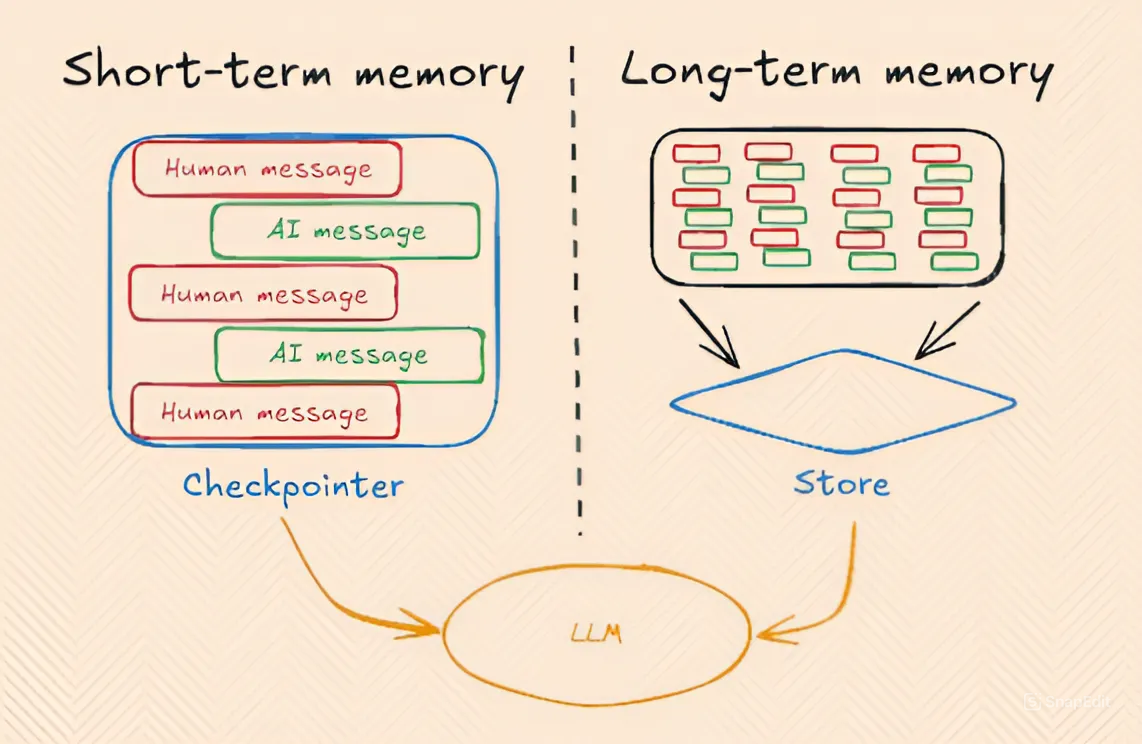 Short-term (working) memory is just this growing stack of Human/AI messages. Long-term memory is a separate store that this stack gets saved into (and retrieved from) across sessions. (The labels "Checkpointer" and "Store" here come from the LangGraph framework — different frameworks use different names for the same idea.)
IV. Long-Term Memory: Remembering Across Sessions
We'll go much deeper on this later, in the Expert track's Advanced Memory module — but here's the basic idea for now.
Sometimes, instead of just letting working memory disappear when a session ends, we save a summary or an index of it somewhere outside the model. Later, in a completely different session, that saved information can be pulled back into working memory when it's actually needed — often using RAG (Module 3).
Example: say you upload 5 PDFs to ChatGPT in one session, then start a brand-new session later and ask a question about those PDFs. ChatGPT may still be able to answer — not because the model "remembers" them in its weights (parametric memory), and not because they're sitting in the new session's empty context window (working memory) — but because it automatically indexed those PDFs during the earlier session, and can retrieve the relevant parts back into context now that you're asking about them again.
V. Putting It All Together
| Parametric | Working (Short-Term) | Long-Term | |
|---|---|---|---|
| Stored in | Model weights | Context window | External storage (DB, vector store, files) |
| Persistence | Permanent | Temporary — gone when the session ends or context fills up | Persists across sessions |
| Precision | Fuzzy — hard to recall exactly among billions of documents | Very precise — the LLM reads it directly | Precise once retrieved back into context |
| Created by | Training / fine-tuning (Module 2) | A growing stack of messages | Explicit save + retrieval, often via RAG (Module 3) |
| Analogy | Someone who's read 1,000 books | Someone reading a book open right in front of them | Someone's own notes, looked up later |
The takeaway: the LLM itself has no memory of its own — parametric memory is what training baked into its weights, working memory is what your app is currently showing it, and long-term memory is what your app saves and brings back later.
Mermaid Diagram: Where Working Memory Actually Lives
graph TD
    A[Your App] -->|resends full message stack| B[Context Window = Working Memory]
    B --> C[LLM: stateless during generation]
    C -->|response| A
    A -->|appends response to the stack| A
Tutorial Progress
graph LR
    A[Module 1: LLMs] --> B[Module 2: Training]
    B --> C[Module 3: RAG]
    C --> D[Module 4: Tools]
    D --> E[Module 5: Memory]
    E --> F[Module 6: Agents]
    F --> G[Module 7: Multi-Agent]
    style A fill:#90EE90
    style B fill:#90EE90
    style C fill:#90EE90
    style D fill:#90EE90
style E fill:#FFFF00Summary
There are three kinds of memory, and they're not interchangeable: parametric memory (permanent, but fuzzy at scale, baked in by training), working memory (precise but temporary — just a growing stack of messages re-sent every call), and long-term memory (saved outside the model and retrieved back into working memory when needed, often via RAG). Next up: agents, which lean on this same working memory to plan and act across many steps.
Quick Check: What are the three types of memory? Why is parametric memory imprecise even though it's permanent? Why do we call short-term memory "working memory"? How does information from long-term memory make it back into the LLM's context?
Keep going! 🚀
Previous Module: Module 4: LLM Tool Calling Next Module: Module 6: AI Agents: From Single Call to Multi-Step Reasoning